NEW YORK PHILHARMONIC’S
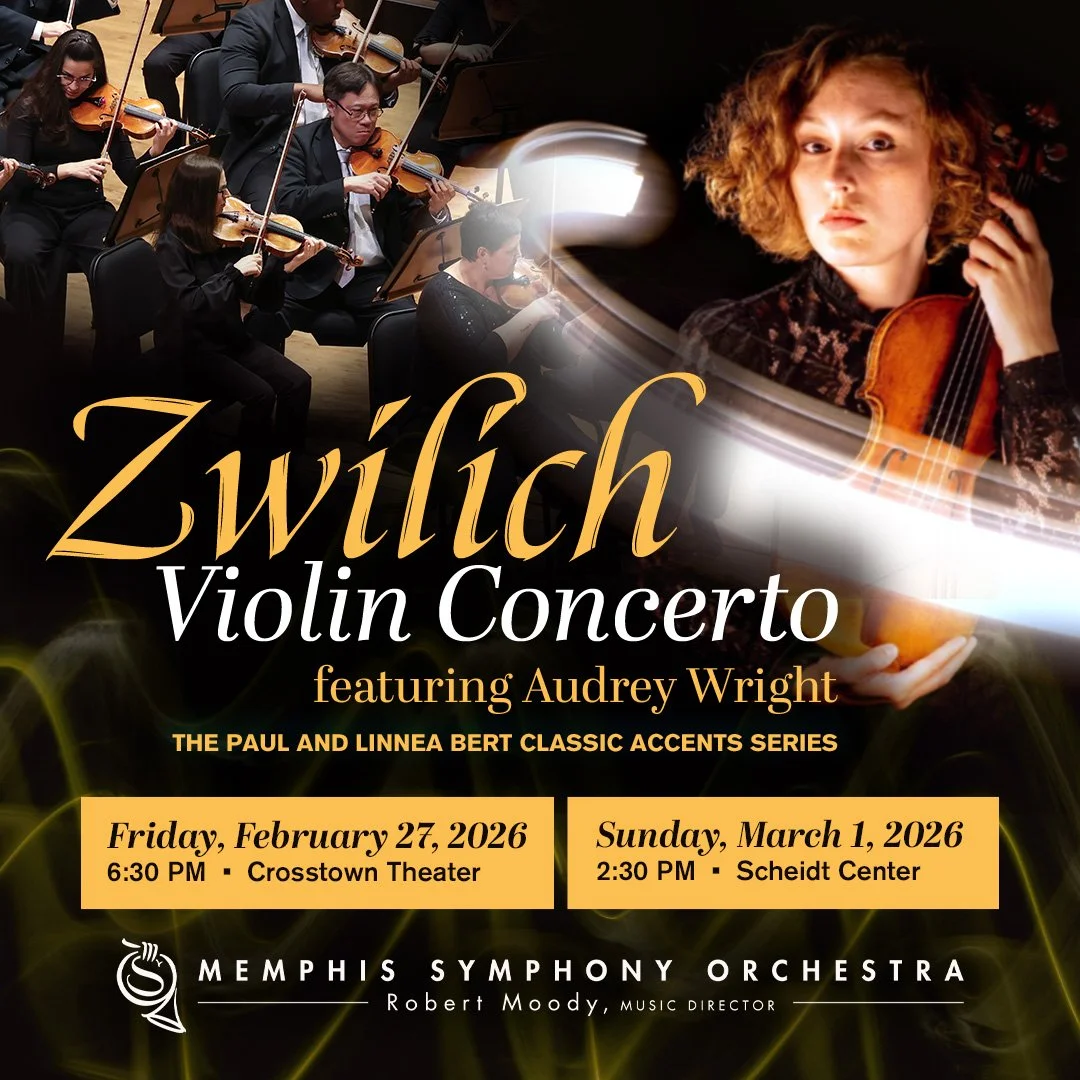
AUDREY WRIGHT PLAYS
ZWILICH VIOLIN CONCERTO
Kyle Dickson, conductor
Audrey Wright, violin
Friday, February 27, 2026 · 6:30pm · Crosstown Theater
Sunday, March 1, 2026 · 2:30pm · Scheidt Center
Program
-
JESSIE MONTGOMERY
b. 1981
StarburstELLEN TAAFFE ZWILICH
b. 1939
Concerto for Violin and Orchestra
Audrey Wright, violin -
There will be a 20-minute intermission between the first and second halves of the performance.
-
ERICH KORNGOLD
1897-1957
Suite from Much Ado About Nothing
I. Overture
II. Mädchen in Brautgemach [The Maiden in the Bridal Chamber]
III. Holzapfel und Schlehwein [Dogberry and Verges]
IV. Intermezzo (Gartenszene) [Garden Scene]
V. Hornpipe [Masquerade]MAURICE RAVEL
1875-1937
Le Tombeau de Couperin
I. Prélude
II. Forlane
III. Menuet
IV. Rigaudon -
Classic Accents Two (February/March 2026)
by Michelle Pellay-WalkerJessie Montgomery (b. 1981): Starburst
Jessie Montgomery’s Starburst exists in three different versions: one for string orchestra (the original version), one for full orchestra, and one for chamber ensemble. It is the latter that will be performed on this concert set, featuring two flutes, two clarinets, harp, piano, and strings. On her website, Ms. Montgomery describes the piece as follows: “…a play on imagery of rapidly changing musical colors. Exploding gestures are juxtaposed with gentle fleeting melodies in an attempt to create a multidimensional soundscape. A common definition of a starburst: ‘the rapid formation of large numbers of new stars in a galaxy at a rate high enough to alter the structure of the galaxy significantly’ lends itself almost literally to the nature of the performing ensemble who premiered the work, The Sphinx Virtuosi, and I wrote the piece with their dynamic in mind.”
Ellen Taaffe Zwilich (b. 1939): Concerto for Violin and Orchestra
First performance: March 1998: New York City (Carnegie Hall), Orchestra of St. Luke’s, Hugh Wolff, conductor, Pamela Frank, soloist
“My new Violin Concerto is a very personal and deeply felt contemporary response to the instrument I have been closest to throughout my musical life. Perhaps that's why I found the experience of writing my concerto at once a challenge and a labor of love…it is important that the orchestra play a crucial role in the dialogue, but I also want the violin to be free to be expressive in its mezzo piano range. So, achieving good balances in a rich musical setting is a major challenge in writing a violin concerto. And since I write directly on the orchestra (rather than "orchestrate" from a piano score), it is a question of having at all times a sense of the forces at hand and "sculpting" them as a part of the form of the piece.” [extracted from the composer’s website]
The “forces at hand” clearly show Ellen Taaffe Zwilich’s interest in the sonic impact of the orchestra, and includes woodwinds in pairs plus auxiliary family members, two horns, two trumpets, timpani, harp, and strings. The concerto is written in three separate movements. The first movement features an early entrance by the soloist following a brief introduction, is loosely in A-B-A form (slow-fast-slow), and includes several cadential moments. The influence of Johann Sebastian Bach will easily be heard in the second movement; the first half of the movement features a repeated eight-bar phrase that recalls the chaconne at the end of the Violin Partita No. 2 in D Minor. Movement three is another loosely ternary form movement—and it’s really Off To The Races in the middle section!!
Erich Korngold (1897-1957): Suite from Much Ado About Nothing, Opus 11
First performance: Vienna (Schönbrunn Palace), 1920.
Erich Korngold's music for William Shakespeare's comedy, Much Ado about Nothing, Opus 11, recalls other composers who have provided well-known incidental music for stage works, most notably Felix Mendelssohn’s Midsummer Night’s Dream (also by Shakespeare), and Edvard Grieg’s two Peer Gynt (Henrik Ibsen) suites. The music was composed in 1919 for a production of the play that would take place at Schönbrunn Palace in Vienna a year later. There are originally 23 musical selections; five of these are included in this suite, which is scored for single woodwinds plus piccolo, two horns, trumpet, trombone, timpani, percussion, harp, piano, harmonium, and strings.
Maurice Ravel (1875-1937): Le Tombeau de Couperin
First performance (orchestral version): February 1920: Pasdeloup Orchestra, René-Emmanuel Baton, conductor
Le Tombeau de Couperin (The Tomb of Couperin) was originally composed by Maurice Ravel for solo piano over a three-year period between 1914 and 1917, with four of the original six movements orchestrated by the composer two years later. Each movement is dedicated to the memory of a friend of the composer, who was lost during World War I. The emphasis on dance forms, combined with the swirling woodwind figures, creates a joyful memorial to his fallen friends. The orchestration for this work features woodwinds in pairs plus piccolo and English horn, two horns, trumpet, harp, and strings. The four movements extracted from the original piano version are the Prélude, the Forlane, the Menuet, and the Rigaudon.
On Stage

-
American conductor Kyle Dickson has built a reputation as an inspiring and compelling presence on the podium. Recipient of the 2021 Grant Park Music Festival Advocate for Arts Award and the Concert Artists Guild's Richard S. Weinart Award, Dickson serves as the Madeleine Luce Moore Assistant Conductor Chair of the Memphis Symphony Orchestra and Conductor of the Memphis Youth Symphony. From 2021-2023, Dickson was a Salonen Fellow with the San Francisco Symphony under the guidance of Music Director Esa-Pekka Salonen and Assistant Conductor of the Chicago Sinfonietta under Maestra Mei-Ann Chen.
Dickson has recently appeared as guest conductor with the San Francisco Symphony, Minnesota Orchestra, National Symphony Orchestra, Detroit Symphony, Wichita Symphony, Oakland Symphony, and the Louisville Orchestra. In 23/24, Dickson made debuts with the Pasadena Symphony, Marin Symphony, Portland Symphony (ME), and Ballet Memphis. As Cover Conductor, Dickson has been engaged by the New York Philharmonic, St. Louis Symphony, and the San Diego Symphony as well as serving as Assistant Conductor for concerts with the NDR Elbphilharmonie Hamburg, Orchestre de Paris, and the Chicago Symphony Orchestra. In 2022, he was selected as a Conducting Fellow at the National Orchestral Institute’s Conducting Academy led by Marin Alsop and he was the 2023 Festival Napa Valley Revzen Conducting Fellow.
A passionate educator regarded for his commitment to youth as well as diversity in the arts, Dickson was awarded the Weissberg Prize and the 2024 Spirit of Detroit Award for his series, MUSIC REPRESENTS. He was Assistant Conductor for Carnegie Hall’s 2022 National Youth Orchestra (NYO2) and has worked closely with the Inner City Youth Orchestra of Los Angeles, Colburn Academy Virtuosi, Chicago Youth Symphony, and the Claremont Young Musicians Orchestra among other youth ensembles across the country. He has been guest conductor of the CSO Young Artists Competition, Civic Orchestra of Chicago, and in 24/25 makes his debut with the Equity Arc Orchestra.
Trained as a violinist, Dickson was a prizewinner at the 2010 NANM National Concerto Competition. As guest artist, he’s held chamber music residencies at Indiana University-South Bend, the United World College of South East Asia, and served on the Violin and Chamber Music faculty at the New Music School (Chicago). He has performed with the Grant Park Festival Orchestra, Lansing Symphony, Quad City Symphony, and as Concertmaster of the Chicago Composers Orchestra. Additionally, his playing can be heard on albums by recording artists such as John Legend, Chance the Rapper, Jessie J and others as a member of the Matt Jones/Recollective Orchestra. Dickson studied Conducting at the Colburn School and Northwestern University as student of Esa-Pekka Salonen and Victor Yampolsky.
-
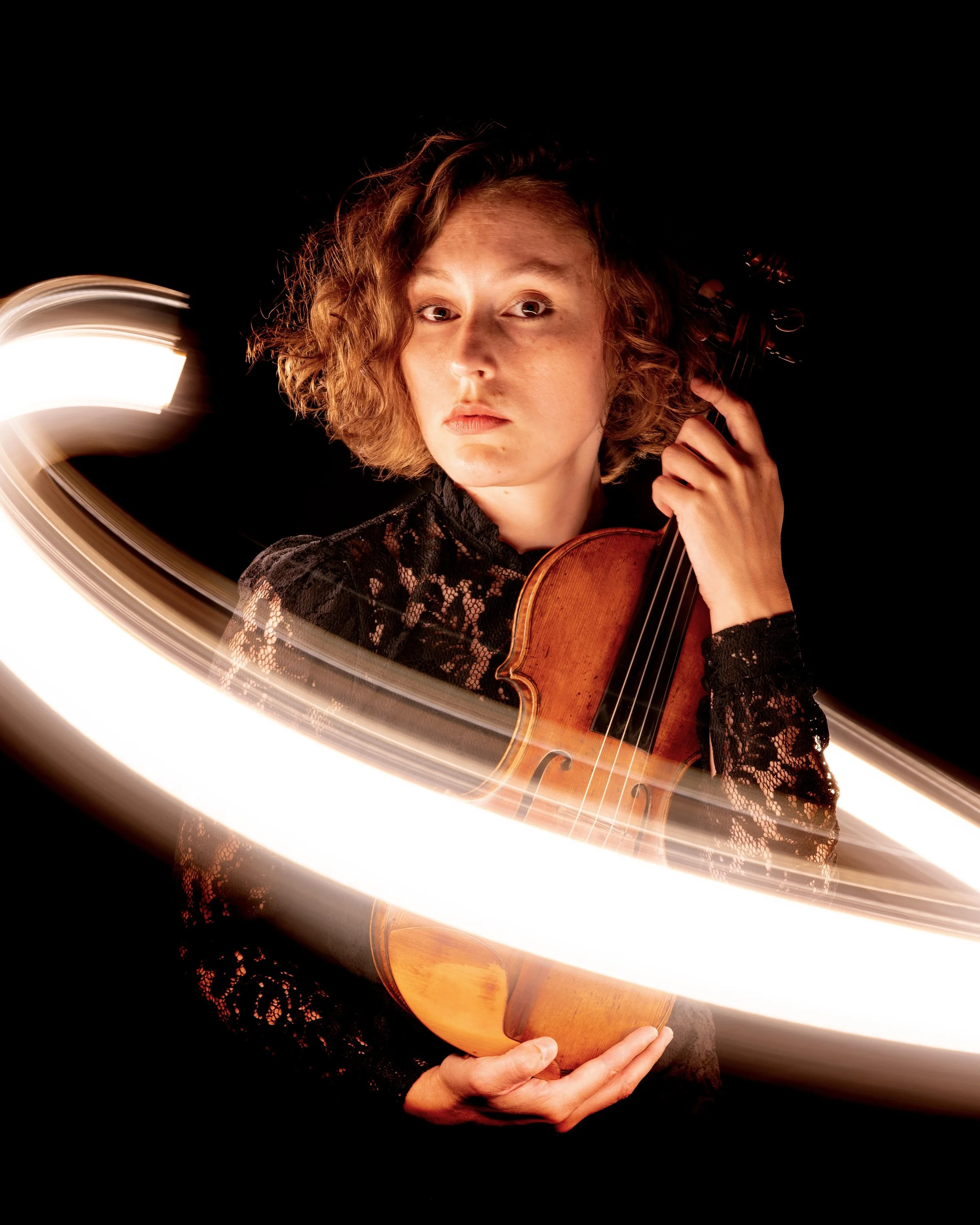
Violinist Audrey Wright has earned international acclaim as a multifaceted artist across solo, chamber music, orchestral, and pedagogical realms. Currently a member of the New York Philharmonic and concertmaster of the Baltimore Chamber Orchestra, she previously served as associate concertmaster of the Baltimore Symphony Orchestra and held positions with the Excelsa Quartet, New World Symphony, and Verbier Festival Chamber Orchestra. With a passion for innovative programming and juxtaposing a wide range of musical styles, her captivating performances often incorporate early music, new and undiscovered works, and cross-genre collaborations of all kinds. She has performed as soloist with orchestras across the US, and her debut album with pianist Yundu Wang, Things In Pairs, was released on Navona Records in 2022.
In addition to performing, Wright is a passionate teacher and has developed a specialty in coaching orchestral audition preparation. In 2020 she released a YouTube series of tutorial videos that is widely used by musicians around the world. She previously was Director of the Homewood Chamber Music Seminar at Johns Hopkins University and coached chamber music at the University of Maryland, and is a recurring visiting faculty member at the New World Symphony and The Orchestra Now at Bard College. Wright holds degrees from the New England Conservatory of Music and received her DMA from the University of Maryland. Her primary teachers have included David Salness, Lucy Chapman, Bayla Keyes, and Magdalena Richter. She plays on a 1753 J.B. Guadagnini violin generously on loan from the Alsop Trust.
Memphis Symphony Orchestra
-
Marisa Polesky*, Concertmaster
The Joy Brown Wiener Chair
Diane Cohen, Assistant Concertmaster
Wen-Yih Yu, Assistant Principal
Carissa Perez, Assistant Principal
Michael Klyce
Sebastian Gavirila -
Erin Kaste, Principal
The Dunbar and Constance Abston Chair
Yennifer Correia, Assistant Principal
Ann Pretzer, Assistant Principal
Janaina Fernandes
Jamie Weaver
Ana Maria Trujillo -
Michelle Pellay-Walker, Principal
The Corinne Falls Murrah Chair
Aaron Tubergen, Assistant Principal
Beth Luscombe, Assistant Principal
Michael Brennan -
Ruth Valente Burgess, Principal
The Vincent de Frank Chair
Iren Zombor, Assistant Principal
Jonathan Kirkscey, Assistant Principal
Jeffrey Jurciukonis -
Scott Best, Principal
Chris Butler, Assistant Principal
Sean O’Hara -
Shantanique Moore*, Principal
The Marion Dugdale McClure Chair
Delara Hashemi -
Lani Smith*, Principal
The Paul and Linnea Bert Chair
Sandy D’Amato, Assistant Principal
Shelly Sublett, Assistant Principal -
Andre Dyachenko, Principal
The Gayle S. Rose Chair
Rena Feller
Nobuko Igarashi -
Susanna Whitney, Principal
The Carolyn Horrell Heppel Chair
Michael Scott
Chris Piecuch -
Caroline Kinsey, Principal
The Morrie A. Moss Chair
Robert Patterson -
Elizabeth Carter, Principal
The Smith & Nephew Chair
J. Michael McKenzie -
Greg Luscombe, Principal
-
Ed Murray, Principal
-
David Carlisle*, Principal
Bill Shaltis -
Adrienne Park, Principal
The Buzzy Hussey and Hal Brunt Chair -
Jonathan Tsay
-
Frances Cobb Kenney, Principal
The Ruth Marie Moore Cobb Chair
*Artist in Residence